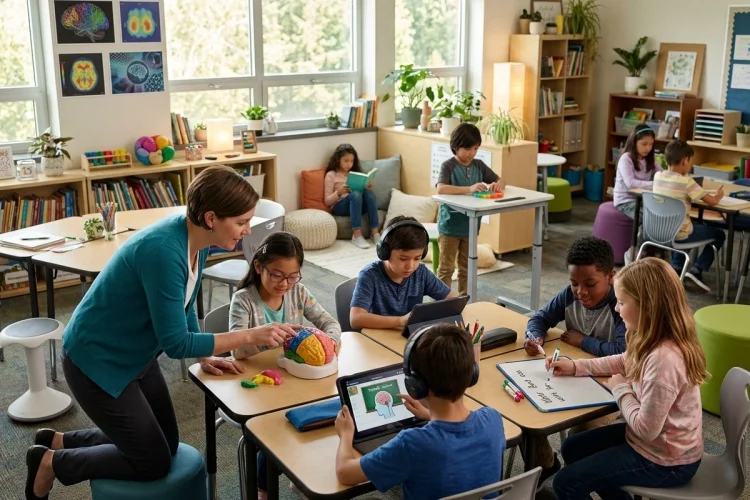
Every classroom contains learners who differ in attention, memory, language, prior knowledge, motivation, sensory needs, and the speed at which they process new information.
Expecting all of them to learn effectively through exactly the same route can create barriers that have little to do with the actual subject being taught.
This is where brain-informed teaching can become useful.
Brain-informed teaching does not mean decorating lessons with neuroscience vocabulary or claiming that a particular activity “activates both sides of the brain.”
In fact, educational research shows that neuromyths such as fixed learning styles continue to influence teaching beliefs despite weak evidence for matching instruction to those categories.
A more responsible approach uses well-established knowledge about attention, working memory, stress, memory, practice, and learner variability to improve classroom design.
Understanding how brain-informed teaching can support inclusive classrooms therefore means asking a practical question: how can teachers reduce unnecessary barriers while keeping learning meaningful, challenging, and accessible to a wider range of students?
1. Start With Learner Variability, Not a “Normal Brain”
Inclusive teaching begins by recognizing that learner variability is expected rather than exceptional.
Students differ in what they already know, how easily they hold information in working memory, what captures their attention, how they communicate, and which environmental conditions help them participate.
Universal Design for Learning, or UDL, is built around this idea of learner variability. CAST encourages educators to provide flexible options for engagement, representation, and action or expression rather than designing lessons around one imagined average learner.
This does not mean creating thirty separate lesson plans.
Suppose a teacher explains the water cycle verbally while also providing a clear labeled diagram. Instructions remain visible on the board, and students later demonstrate understanding through a structured written explanation.
Those small design decisions may help many students at once.
Inclusive instruction often works best when flexibility is built into the lesson before individual students begin struggling.
2. Reduce Barriers That Are Not Part of the Learning Goal
UNESCO describes barriers to inclusive education as obstacles that prevent learners with diverse needs from fully participating in educational opportunities. These barriers can be physical, social, institutional, or related to how learning is organized.
Consider a science lesson where the real goal is understanding photosynthesis.
If students must remember six verbal instructions before beginning the activity, then memory for instructions has accidentally become part of the assessment.
A student may understand photosynthesis perfectly well but still struggle because they forgot step four.
Brain-informed teaching asks teachers to separate essential difficulty from unnecessary difficulty.
If remembering the instructions is not the objective, keep them visible.
If handwriting speed is not being assessed, consider whether every answer must be handwritten under strict time pressure.
Removing unnecessary barriers does not lower standards. It makes the intended standard clearer.
3. Respect the Limits of Working Memory
Working memory allows students to temporarily hold and manipulate information while reading, solving problems, following instructions, and reasoning.
But its capacity is limited.
Research on working memory in educational contexts emphasizes its importance for classroom tasks and academic performance.
Imagine explaining a new maths procedure while students simultaneously copy a long paragraph, watch an animation, remember four instructions, and listen to additional explanations.
Even motivated learners can become overloaded.
A more inclusive approach introduces complexity gradually.
Teachers can break instructions into stages, keep essential information visible, pre-teach unfamiliar vocabulary, and use worked examples before expecting independent performance.
These strategies can be particularly helpful for learners who experience working-memory difficulties, but they often improve clarity for everyone.
Support Without Creating Dependence
The goal is not to permanently simplify tasks.
Support should gradually decrease as students develop knowledge and independence.
A teacher might first model the entire procedure, solve the next example with students, provide prompts on another example, and finally ask learners to work independently.
The academic goal stays the same while the amount of support changes.
4. Design for Attention Instead of Constant Stimulation
Students cannot deeply process everything in their environment simultaneously.
A brain-informed classroom therefore does not need to be constantly exciting.
It needs to help students identify what matters right now.
During an important explanation, unnecessary notifications, unrelated videos, background conversations, or crowded visual material may compete for limited attention.
Inclusive lesson design can make the relevant signal clearer.
Highlight the important part of a diagram. Tell students what question they should answer while reading. Pause after a complicated explanation and ask them to summarize the main idea.
This can particularly help students who find attention regulation difficult, but again, the strategy is useful more broadly.
A classroom does not become brain-friendly by supplying maximum stimulation. It becomes easier to learn in when students can tell where their attention should go.
5. Use Retrieval Practice to Make Memory More Accessible
Presenting information is only the beginning of learning.
Students also need opportunities to bring knowledge back from memory.
Research on the testing effect shows that retrieving previously learned information can improve later retention rather than simply measuring what students already know. Classroom research has also demonstrated benefits from retrieval practice using actual course material.
Inclusive retrieval does not need to mean stressful graded testing.
A teacher might begin class with:
“What are three things you remember from yesterday?”
Students could answer privately before checking their notes.
Another option is to ask learners to label a diagram from memory, explain a concept to a partner, or answer a short low-stakes quiz.
These activities make memory visible to both teachers and students.
They also reduce reliance on a single high-stakes assessment to discover what learners have forgotten.
6. Consider Stress as Part of the Learning Environment
Stress and learning have a complicated relationship.
Some challenge can increase alertness, but excessive or poorly timed stress can interfere with attention, learning, and memory. Reviews of neuroscience research in education describe ways stress can influence learning processes across school-age populations.
This has important implications for inclusion.
A student who is afraid of being publicly embarrassed may use cognitive resources worrying about mistakes instead of solving the problem.
A learner who does not understand unpredictable classroom routines may spend attention trying to anticipate what happens next.
Reducing unnecessary stress does not mean lowering expectations.
Teachers can maintain demanding academic work while making routines predictable, instructions clear, mistakes safe to discuss, and assessment expectations transparent.
The challenge should come from thinking deeply, not from avoidable uncertainty or humiliation.
7. Use Neurodiversity to Think About Access, Not Labels
Brain-informed teaching should not turn neuroscience into a new system for labeling students.
Neurodivergent learners are not one uniform group.
An autistic student may need a quieter environment but excel at detailed analysis. Another autistic learner may have completely different strengths and support needs. Students with ADHD, dyslexia, or other differences are equally diverse.
Recent educational literature on neurodiversity emphasizes adjusting learning environments and reducing barriers rather than assuming that neurodivergent students all require the same teaching method.
This is an important distinction.
Avoid:
“Students with this brain type need this activity.”
Prefer:
“This learner is having difficulty accessing this task. What is creating the barrier?”
The second question leads toward practical support instead of stereotypes.
8. Offer Multiple Routes Without Falling Into the Learning-Styles Myth
Providing different ways to access learning is not the same as teaching according to fixed “visual,” “auditory,” or “kinesthetic” learning styles.
Research continues to identify learning-styles matching as a persistent educational neuromyth.
A diagram may help because the concept is spatial.
Listening may matter because students are learning pronunciation.
Physical practice is essential when students are learning a movement.
The instructional format should match the content and learning goal, not a label attached to the student.
Inclusive teachers can still use words, images, models, demonstrations, discussion, and hands-on activity. The difference is that these methods are selected because they communicate information effectively.
Flexibility is useful. Fixed neurological categories are not.
9. Build Feedback and Second Attempts Into Learning
Inclusive teaching also means giving students opportunities to improve.
A final grade tells students where they finished. Useful feedback helps them decide what to do next.
Imagine a learner receives:
“Incorrect.”
Compare that with:
“Your first step is correct. Check how you converted the fraction before multiplying.”
The second response gives the learner a direction.
Feedback becomes even more useful when students have another opportunity to act on it.
A powerful classroom cycle is:
attempt → feedback → correction → another attempt.
This approach makes mistakes part of instruction instead of treating them as permanent evidence of ability.
It can also reveal whether the real difficulty comes from missing knowledge, misunderstanding instructions, memory demands, or something else.
10. Brain-Informed Teaching Should Stay Humble
Neuroscience can enrich educators’ understanding of learning, but it cannot provide a simple teaching recipe.
Brains are enormously complex, and classroom learning also depends on language, culture, relationships, prior knowledge, instruction, motivation, environment, and opportunity.
Teachers should therefore be cautious when a commercial program promises to “activate neural pathways,” “balance the hemispheres,” or transform learning through a student’s supposed brain type.
Neuromyth research shows how easily genuine neuroscience can become oversimplified when translated into educational claims.
A better test is straightforward:
Does this teaching strategy improve students’ access to meaningful learning, and is there credible evidence behind it?
Brain-informed education works best when neuroscience supports good instructional reasoning rather than replacing it.
Understanding how brain-informed teaching can support inclusive classrooms does not require teachers to become neuroscientists.
It requires using reliable knowledge about learner variability, attention, working memory, stress, memory, and practice to make better instructional decisions.
UDL similarly encourages educators to anticipate variability and provide flexible routes for engagement, representation, and expression.
The goal is not to make every student learn in exactly the same way or to reduce academic expectations. It is to remove barriers that are unrelated to the learning goal while providing enough structure for diverse students to participate and progress.
Start small. Look at one upcoming lesson and ask: What unnecessary memory, attention, sensory, or communication barriers could prevent a capable student from showing what they know?
Removing even one of those barriers can make a classroom more inclusive without making the learning less rigorous.