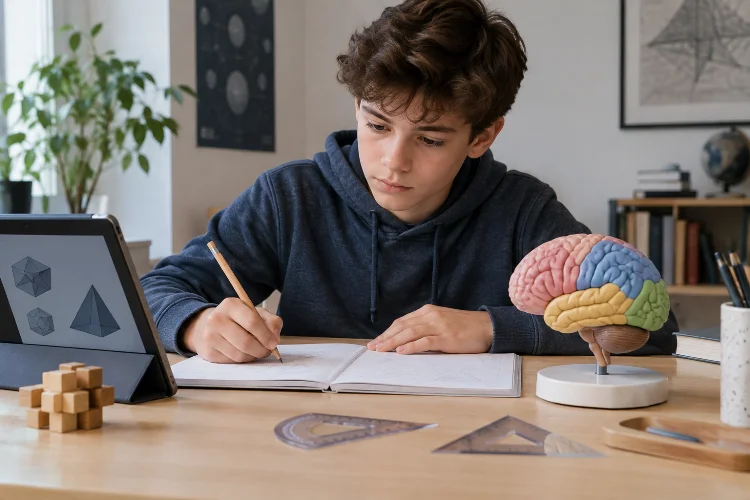
Imagine sitting down to solve a math problem. You look at the numbers, remember a formula, decide which calculation to use, write an answer, and check whether it makes sense.
It feels like one task. Inside your brain, however, several regions are cooperating at the same time.
The human cerebral cortex is commonly divided into four major lobes: the frontal, parietal, temporal, and occipital lobes.
Each has areas that are especially important for certain functions, but they do not behave like four separate computers. Learning usually depends on communication across multiple brain networks.
Understanding how different brain lobes contribute to learning tasks can make neuroscience surprisingly practical.
It helps explain why reading is different from memorizing a song, why solving a spatial puzzle requires different mental resources from planning an essay, and why paying attention is just as important as receiving information.
Let’s take a beginner-friendly tour through these brain regions and see what they are doing while you learn.
Brain Lobes Work Together Rather Than Independently
Diagrams often make the brain look beautifully organized. One area handles vision, another handles language, another controls movement, and everything seems to have its own clearly labeled compartment.
Real brain activity is much more interconnected.
The cerebral cortex contains specialized regions, but complex behaviors depend on networks connecting multiple areas. Even executive functions commonly associated with the frontal lobes involve frontal, parietal, and other brain regions working together.
Consider reading a textbook. Your visual system must process the shapes of letters, language networks interpret the words, attention systems decide what deserves focus, and memory systems connect the new material with information you already know.
So when we say a particular lobe “does” something, it is usually more accurate to say that the region makes an especially important contribution to the task.
The Frontal Lobe Helps You Plan, Focus, and Solve Problems
The frontal lobe sits at the front of the cerebral cortex and plays a major role in many learning activities that require deliberate control.
Its prefrontal regions are associated with working memory, planning, decision-making, behavioral regulation, and cognitive flexibility. The frontal lobe also contains motor regions and, typically in the dominant hemisphere, areas important for producing speech.
Learning Tasks That Depend Heavily on Frontal Systems
Imagine writing an essay.
You need to decide what your main argument will be, organize ideas, ignore irrelevant thoughts, remember what you have already written, and revise sentences that do not work. Those are classic examples of executive control.
The frontal lobe becomes especially relevant when learning is not automatic.
A beginner solving an algebra equation may need to consciously think through every step. With practice, some parts become faster and require less deliberate attention, but early learning can place considerable demands on working memory and executive control.
This also helps explain why distraction can be so disruptive. If your attentional resources are constantly jumping between studying, notifications, videos, and messages, maintaining the mental goal becomes more dificult.
The Parietal Lobe Helps With Numbers, Space, and Sensory Information
Move toward the upper-back portion of the cerebral cortex and you reach the parietal lobe.
This region processes somatosensory information such as touch and body position and also contributes to spatial awareness, attention, and several higher cognitive abilities.
Damage to parts of the dominant parietal cortex can even produce difficulties involving mathematics, writing, and left-right discrimination.
That makes the parietal lobe particularly interesting for education.
When you estimate which object is farther away, follow a diagram, manipulate quantities, or understand the relationship between objects in space, parietal systems may be heavily involved.
Math learning is a good example. Calculating is not simply “remembering numbers.” Students must understand quantities, spatial relationships, symbols, rules, and sequences while often coordinating those processes with frontal executive systems.
The parietal cortex is also important for directing attention toward relevant parts of the environment, showing once again that learning depends on coordiantion rather than one isolated brain area.
The Temporal Lobe Supports Memory, Hearing, and Language
The temporal lobes sit roughly along the sides of the brain near the temples.
They are deeply connected with learning because they participate in auditory processing, language, memory, and emotion. Important structures associated with memory, including the hippocampus, are located within the medial temporal region.
Think about learning a new language.
You hear unfamiliar sounds, try to distinguish words, attach meanings to them, remember vocabulary, and eventually understand entire sentences. Temporal regions contribute to several stages of that process.
The superior temporal area is especially relevant for auditory information, while language-comprehension networks in the dominant hemisphere help connect speech with meaning.
Long-term memory also depends on distributed brain systems, but evidence has long demonstrated an important role for temporal regions in memory formation and retrieval.
This is why listening to a lecture is far more complicated than simply detecting sound. Your brain has to turn sound waves into meaningful information and somehow remeber enough of that information for it to become useful later.
The Occipital Lobe Turns Visual Input Into Useful Information
At the back of the brain sits the occipital lobe, the region most strongly associated with visual processing.
The primary visual cortex receives and processes visual information, while additional visual areas help analyze features such as shape, color, depth, motion, and object identity. Visual information then interacts with regions in the temporal and parietal lobes through larger processing pathways.
This means your occipital cortex is extremely busy during many classroom activities.
When you read a word, examine a graph, watch a demonstration, identify a geometric shape, or recognize an object in a biology diagram, visual signals must first be processed before higher-level interpretation can occur.
But the occipital lobe does not “understand” a textbook by itself.
Seeing the letters is only the beginning. The information must connect with language, attention, and memory networks before those shapes become meaningful ideas.
Reading Shows How Several Lobes Cooperate
Reading provides one of the clearest examples of why dividing learning into isolated brain regions can be misleading.
First, visual information reaches the occipital cortex. Networks extending toward temporal regions help identify objects and written forms, while language-related areas contribute to connecting symbols with sounds and meaning.
Parietal areas participate in attention and the integration of sensory information, while frontal systems help maintain concentration, interpret complex sentences, make predictions, and organize responses.
Research on aphasia also illustrates these connections. Written language involves communication from visual-processing regions toward language networks rather than being handled by one single “reading center.”
So even the apparently simple act of reading one paragraph involves a remarkable amount of brain teamwork.
Different Learning Tasks Recruit Different Networks
Not every learning activity places equal demands on each region.
Memorizing spoken vocabulary relies heavily on auditory and memory networks. Studying a map places greater demands on visual-spatial processing. Writing a research paper requires extensive executive control and language processing.
Learning a dance sequence adds another layer because visual information, body position, motor planning, timing, memory, and attention must all work together.
This is also why someone can be very good at one type of learning and struggle with another. Cognitive abilities are not controlled by a single universal “intelligence spot” in the brain.
Different tasks recruit partially different networks, and experience can make some of those processes more efficient over time.
What This Means for Better Learning
Knowing the basic functions of the brain lobes does not produce a magical study hack, but it can improve the way we think about learning.
A useful lesson is to interact with information in several ways.
If you are learning anatomy, for example, you might read an explanation, examine a diagram, say the concept aloud, draw the structure from memory, and explain it to another person.
Those activities are not identical. They require different combinations of visual processing, language, memory, motor activity, spatial thinking, and executive control.
Another useful principle is to avoid assuming that seeing information means you have learned it. Looking at a diagram may make it feel familar, but successfully explaining or recreating that diagram without looking requires much deeper retrieval.
Learning becomes stronger when the brain has to actively work with information rather than simply receive it.
The frontal, parietal, temporal, and occipital lobes each make important contributions to learning, but none works completely alone.
Frontal systems help with planning, attention, working memory, and problem-solving. Parietal regions contribute to sensory integration, spatial thinking, attention, and numerical processing.
Temporal regions are important for hearing, language, and memory, while the occipital lobe provides the foundation for visual processing.
Together, these areas create the networks that allow us to read, calculate, remember, communicate, and develop new skills.
Next time you study something difficult, experiment with multiple approaches. Read it, visualize it, explain it, write it, and retrieve it from memory. You may be giving several brain systems a chance to work together.