When you practice a guitar chord, memorize a new password, improve your typing speed, or finally understand a difficult maths problem, something remarkable is happening inside your brain.
Billions of nerve cells are constantly receiving, processing, and passing information through interconnected networks.
These cells are called neurons, and their ability to communicate is at the heart of learning.
Understanding how neurons send messages during learning and practice does not require a neuroscience degree. At its simplest, neurons use electrical signals within individual cells and mostly chemical signals to communicate across the tiny gaps between cells.
With repeated experience, some of these connections can also change, helping the nervous system adapt to new information and skills.
That adaptability is one reason practice can gradually turn something difficult into something familiar. So, what actually happens from the moment one neuron receives information to the point where repeated practice changes a neural network? Let’s follow the message.
1. Neurons Are the Brain’s Communication Cells
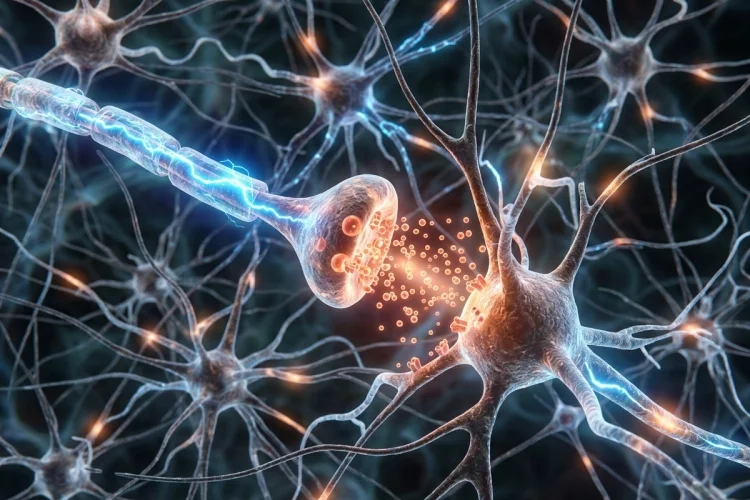
A neuron is a specialized cell designed to receive and transmit information. Although neurons come in many shapes and sizes, most have three important components: dendrites, a cell body, and an axon.
Dendrites mainly receive incoming signals from other neurons. The cell body integrates much of that incoming information, while the axon carries electrical signals away from the cell toward other cells.
Imagine learning the word for an object in another language. Networks involved in hearing, vision, attention, language, and memory may all become active.
Neurons within those networks continually exchange signals so that the sound or written word can eventually become associated with its meaning.
Learning, therefore, is not the work of one neuron. It comes from coordinated activity across enormous networks of connected cells.
2. Electrical Messages Travel as Action Potentials
Neurons maintain a difference in electrical charge between the inside and outside of their membranes. This state creates what is known as a membrane potential.
When incoming signals push a neuron to a sufficient threshold, it can generate a rapid electrical event called an action potential.
Voltage-gated sodium channels play a major role in the rising phase of this electrical signal, while potassium movement contributes to returning the membrane toward its resting state.
An All-or-Nothing Signal
An action potential is often described as an all-or-nothing event. Once the necessary threshold is reached, the neuron generates the signal rather than producing a tiny half-strength version of it.
The action potential then travels along the axon toward its terminal.
You can think of this less like water gradually flowing through a pipe and more like a rapidly regenerated electrical wave moving along a communication cable.
In many neurons, myelin wraps around sections of the axon. Gaps called nodes of Ranvier allow the action potential to be regenerated along the pathway, helping signals travel efficiently over longer distances.
3. Synapses Allow One Neuron to Message Another
Eventually, the electrical signal reaches the end of the axon. But there is usually a problem: the next neuron is not physically continuous with the first one.
Between the cells is a tiny junction called a synapse.
At many synapses in the brain, the electrical signal is converted into a chemical message.
When an action potential reaches the presynaptic terminal, voltage-dependent calcium channels open. Calcium entering the terminal helps trigger vesicles containing neurotransmitters to release their contents into the synaptic cleft.
The neurotransmitter molecules then cross this tiny gap and bind to receptors on the receiving cell.
Depending on the neurotransmitter, receptor, and neural circuit involved, the message can increase or decrease the likelihood that the receiving neuron will generate its own electrical signal.
This combination of electrical and chemical signaling allows information to move through complex neural networks.
4. Neurotransmitters Help Shape the Message
Neurotransmitters are chemical messengers used by neurons. The nervous system uses many different types, including glutamate, GABA, dopamine, acetylcholine, serotonin, and norepinephrine.
They do not all perform one simple universal job. Their effects depend partly on the receptors they activate and where those receptors are located.
For example, glutamate is widely involved in excitatory communication within the brain and is especially important in research on synaptic plasticity. GABA commonly contributes to inhibitory signaling, helping control how easily neurons become active.
This balance between excitation and inhibition is important.
Learning would not work well if every neuron simply became more active whenever you practiced something. Neural circuits need to strengthen useful patterns while controlling irrelevant or excessive activity.
After neurotransmitters have delivered their signals, they also need to be cleared or deactivated. Depending on the chemical, this may happen through reuptake, enzymatic breakdown, or diffusion away from the synapse.
5. Learning Can Change the Strength of Synapses
Sending messages explains neural communication, but learning adds another important idea: the connections themselves can change.
This ability is known broadly as neural plasticity. At synapses, changes in the effectiveness or strength of communication are called synaptic plasticity.
One extensively studied example is long-term potentiation, or LTP. It involves a persistent increase in the effectiveness of synaptic transmission following particular patterns of activity and has long been studied as a possible cellular mechanism related to learning and memory.
The opposite process can also occur. Some activity patterns can reduce synaptic strength, a phenomenon called long-term depression or LTD.
This matters because useful learning requires flexibility rather than simply strengthening every connection.
When you learn a new phone number, language phrase, piano sequence, or route through a city, patterns of activity across neural networks change. Synaptic plasticity is one mechanism that helps those networks adapt to experience.
6. Practice Gradually Reshapes Neural Networks
Practice repeatedly activates networks involved in a task. Over time, experience can influence how those networks respond and connect.
Research provides striking examples. In a 2009 animal study, researchers observing the motor cortex found that learning a new motor skill was associated with rapid formation and selective stabilization of new dendritic spines, structures where many excitatory synapses are located.
Human brain-imaging research has also demonstrated functional changes in the motor cortex during motor skill learning. A classic fMRI study found evidence of plastic changes in adult motor cortex following practice of a sequential finger movement task.
Think about learning to type without looking at the keyboard.
At first, finding each letter may require deliberate attention. After considerable practice, the sequence becomes faster and more automatic.
Your neurons are not simply “remembering harder.” Networks involved in perception, movement, attention, and memory have adapted through repeated experience.
7. Why Good Practice Matters More Than Mindless Repetition
The idea of brain plasticity sometimes gets simplified into the phrase “practice makes neural connections stronger.” Reality is more complicated.
Not every repetition automatically strengthens every connection involved. The timing and pattern of neural activity, attention, task difficulty, feedback, previous experience, and the particular brain network all matter.
That is why focused practice generally makes more sense than simply repeating something incorrectly hundreds of times.
Suppose you are learning a new guitar chord. Playing it slowly and accurately gives your nervous system repeated experience with the desired movement.
If you constantly practice the wrong finger position, however, you are repeatedly rehearsing an unwanted movement pattern.
Improvement also requires opportunities to notice errors and adjust future attempts.
This is why effective practice often involves a cycle:
attempt → feedback → adjustment → another attempt.
Neurons keep communicating throughout that process while brain networks adapt to the experience.
8. From Difficult Practice to Easier Performance
One of the most satisfying experiences in learning is when something that once required intense concentration begins to feel natural.
Consider riding a bicycle.
A beginner must think about balance, steering, pedaling, braking, and the environment almost simultaneously. After enough experience, many aspects become far less demanding.
That does not mean the brain has stopped working. Instead, practice has altered how efficiently relevant neural systems organize the task.
Similar changes happen when learning handwriting, sports movements, keyboard shortcuts, pronunciation, musical pieces, or other repeated skills.
Practice is therefore not simply about collecting more repetitions. It is a biological process in which experience repeatedly activates neural networks and can gradually change how those networks operate.
9. How to Apply Neuroscience to Everyday Learning
You do not need to monitor your neurons to take advantage of how they learn.
Start by giving a skill genuine attention. Meaningful engagement provides the brain with clearer information than distracted repetition.
Break complicated skills into manageable pieces, practice accurately, and gradually combine those pieces. Regular retrieval can also be useful when learning factual material: instead of repeatedly rereading the answer, try recalling it before checking your notes.
For physical skills, pay attention to feedback. Notice what worked, correct what did not, and repeat the improved version.
Most importantly, expect improvement to be gradual. A difficult skill may require many rounds of neural activity and adaptation before performance becomes noticeably smoother.
The fact that something feels challenging today does not mean the practice is doing nothing. Learning often reflects changes developing across networks rather than one dramatic switch inside the brain.
Understanding how neurons send messages during learning and practice reveals the remarkable biology behind everyday improvement.
Neurons receive information through their networks, generate electrical action potentials, and communicate across many synapses using neurotransmitters.
Learning adds another layer to this process. Experience can modify synaptic communication and reorganize patterns of neural activity, allowing the nervous system to adapt to new information and repeated skills.
That is why focused, accurate practice matters. Whether you are learning a language, studying for an exam, playing an instrument, or improving a physical skill, every practice session gives your brain another opportunity to process information and adjust.
Choose one skill you want to improve, practice it with attention and useful feedback, and give your neural networks repeated opportunities to learn.