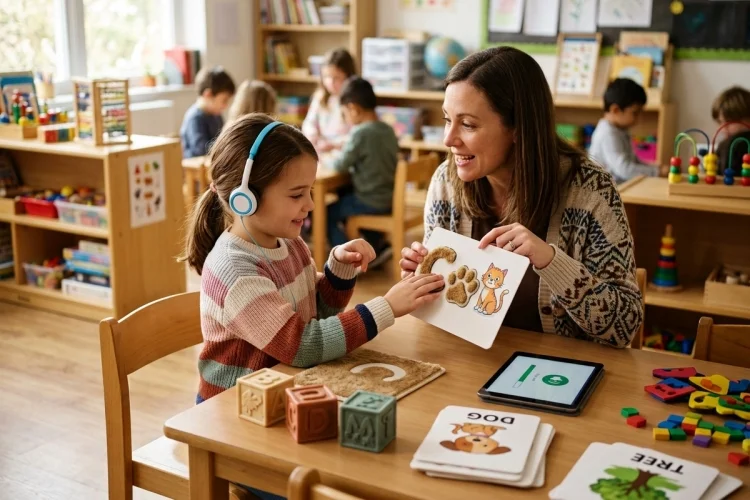
Imagine learning a new word by reading it on a page, hearing someone pronounce it, saying it aloud, and making a gesture that represents its meaning. Compared with simply staring at the word, the experience involves several types of sensory and motor information.
This is the basic idea behind multisensory learning.
Multisensory learning uses information from more than one sensory channel-such as sight, sound, touch, or movement-to support a learning goal.
Research shows that combining sensory information can sometimes improve perception and memory, particularly when the different cues belong together and provide useful information about the same concept.
However, adding more sounds, pictures, movements, and animations does not automatically make a lesson better. Too much redundant or irrelevant information can increase cognitive load and interfere with understanding.
Understanding what multisensory learning means and when it can help allows teachers to use it purposefully rather than treating “more senses” as a universal formula for better learning.
1. What Is Multisensory Learning?
Multisensory learning occurs when learners process related information through more than one sensory or sensorimotor channel.
A student might see a diagram while listening to an explanation. A language learner might hear a word, see its written form, and perform a meaningful gesture. A young learner exploring geometry might handle physical shapes while discussing their properties.
The important word is related.
Simply playing music while students read a diagram does not necessarily create useful multisensory learning. The sensory information should normally contribute to understanding the same idea.
Experiments on audiovisual learning suggest that mutually informative sensory cues can sometimes support learning more effectively than a single cue alone. However, these benefits depend heavily on how the information is designed and what learners are asked to do.
Multisensory learning is therefore best treated as an instructional tool, not a magic learning system.
2. Multisensory Learning Is Not the Same as Learning Styles
One important distinction often gets lost.
Multisensory teaching does not mean matching lessons to a student’s supposed visual, auditory, or kinesthetic learning style.
Students certainly have preferences. One student may enjoy diagrams, while another likes discussion.
But the popular claim that people learn significantly better when teaching is matched to a fixed sensory “learning style” is not supported well enough to justify labeling students this way.
Research continues to document the persistence of this belief among educators despite problems with the underlying learning-styles hypothesis.
Multisensory learning follows a different idea.
Instead of saying:
“Maria is a visual learner, so she needs pictures.”
A teacher might say:
“A labeled diagram and spoken explanation both help explain how blood moves through the heart.”
The method is chosen because it fits the content, not because the student has been assigned a neurological category.
3. Related Sight and Sound Can Strengthen Memory
One area where multisensory effects have been studied extensively is audiovisual learning.
Imagine seeing a picture of a dog while hearing a bark.
The two pieces of information naturally belong together. Research has found that pairing visually presented objects with congruent sounds during encoding can sometimes improve later recognition memory for those objects.
Other experiments have similarly investigated whether studying pictures together with sounds can create memory advantages over unimodal presentation, although the size and reliability of the benefit depend on the learning and testing conditions.
This is useful for teachers because it highlights an important principle:
The senses should reinforce meaning.
If students are learning animal identification, combining the animal’s appearance with its characteristic sound can make sense.
Adding an unrelated sound effect simply because a lesson is supposed to be “multisensory” probably does not.
4. Movement and Gestures Can Support Certain Kinds of Learning
Multisensory learning can also involve the body.
Gestures are especially interesting because they connect language or abstract information with movement.
Studies of foreign-language learning have found benefits when learners accompany new vocabulary with meaningful gestures.
In one study, actively performing gestures during vocabulary learning was compared with observing gestures, providing evidence that movement can contribute to learning under appropriate conditions.
Earlier research also found that iconic gestures-movements representing a word’s meaning-could improve retention of foreign-language vocabulary over time.
Movement can help in other subjects too.
For example, students might physically represent the rotation of planets, use their hands to demonstrate angles, or trace the shape of a letter while saying its sound.
The key is that movement should represent the idea being learned.
Random movement breaks may help attention for other reasons, but they are different from using movement as meaningful instructional information.
5. Multisensory Methods Can Help With Spatial Concepts
Some concepts are difficult because students need to imagine relationships in three-dimensional space.
In these situations, gestures and physical models can provide useful additional information.
A randomized study of anatomy instruction, for example, compared a standard lecture with instruction that included specific hand gestures representing spatial relationships among extraocular muscles.
The researchers investigated whether these gestures could improve students’ understanding of complicated anatomy.
This principle is easy to apply beyond medical education.
Students learning the structure of DNA can manipulate a model. Geography learners can trace the direction of a river across a map. Physics students can use hand movements to represent forces or directions.
These actions are helpful when they make invisible or abstract relationships more concrete.
Multisensory learning is strongest when each sensory element provides information students genuinely need.
6. More Sensory Input Is Not Always Better
A common mistake is assuming:
Two senses are better than one, three are better than two, and five must be amazing.
Learning does not work that simply.
Working memory has limited capacity. If learners must simultaneously process too many competing sources of information, the additional material can become a burden instead of a benefit.
Research on multimedia learning has demonstrated a redundancy effect in some situations. For example, presenting identical written and spoken text alongside other visual information can sometimes interfere with learning rather than improve it.
Imagine a presentation containing an animation, identical paragraphs of written text, full narration, background music, decorative images, and flashing keywords.
Technically, it is highly multisensory.
Educationally, it may be exhausting.
The question should never be:
“How many senses can I include?”
Ask instead:
“Does each source of information help students understand the idea?”
7. Multisensory Learning Works Best When the Cues Match
Meaningful coordination between sensory cues is crucial.
If students see one thing while hearing unrelated information, they may need to split their attention between competing messages.
Congruent information is different.
Seeing a picture of a violin while hearing a violin sound creates a clear connection. Research on object memory has found benefits when sounds accompanying visual objects are semantically congruent with those objects.
Teachers can apply this principle when designing slides and demonstrations.
If you display a diagram while explaining it, point to the part you are discussing.
If students are learning pronunciation, let them see the written word while hearing the relevant spoken form.
If movement is included, make sure the movement represents something about the concept rather than becoming an unrelated classroom performance.
Coordination matters more than sensory quantity.
8. Multisensory Learning Can Be Useful for Vocabulary
Vocabulary provides an easy example of well-designed multisensory instruction.
Suppose students are learning the word spiral.
They could read the word, hear it pronounced, see an image of a spiral, draw one, and trace the movement with a finger.
Those experiences connect several representations to the same meaning.
Research on foreign-language vocabulary has repeatedly examined visual enrichment and gestures, with studies finding that meaningful nonverbal information can support word learning under certain conditions.
But again, relevance matters.
If students are learning an abstract word such as justice, forcing them to perform an arbitrary gesture may be less helpful than discussing examples, contrasting cases, and explaining the concept.
The sensory strategy should follow the learning goal.
9. Consider the Learner and the Task
Multisensory effects are not identical for every learner or every type of material.
For example, researchers studying multimedia instruction in children with dyslexia have examined different combinations of pictures, written text, and spoken text.
The findings show that modality and redundancy effects can vary depending on the learner and instructional design rather than following one universal rule.
This is another reason teachers should avoid formulas such as:
“Always teach through three senses.”
Instead, observe how students respond.
Did the model make the concept clearer?
Did the gesture improve recall?
Did narration help students understand the diagram, or did it create too much information at once?
Instruction should remain responsive to evidence from both educational research and actual student performance.
10. How Teachers Can Use Multisensory Learning Wisely
Effective multisensory teaching can be surprisingly simple.
When teaching vocabulary, combine spoken language with useful written or visual representations.
When teaching spatial relationships, consider models, diagrams, gestures, or manipulatives.
When demonstrating a physical skill, allow students to watch, listen to instructions, and then perform the movement themselves.
For abstract concepts, ask whether an additional representation genuinely clarifies the idea.
Most importantly, remove sensory elements that do not contribute to learning.
A colorful animation may look engaging, but if students spend their attention watching decorative movement instead of thinking about the concept, it is not helping.
The best multisensory lessons are usually coherent rather than crowded.
Every image, sound, object, gesture, or movement should have a reason for being there.
So, what does multisensory learning mean and when can it help? It means using coordinated information from more than one sensory or sensorimotor channel to support a specific learning goal.
Research suggests that related audiovisual cues, meaningful gestures, physical representations, and other carefully designed multisensory experiences can sometimes strengthen understanding or memory.
But more sensory stimulation does not automatically produce better learning. Redundant, irrelevant, or poorly coordinated information can increase mental workload instead.
Teachers should therefore avoid both extremes: multisensory learning is neither a miracle method nor something to ignore.
Start with the concept. Then ask which combination of seeing, hearing, touching, speaking, or moving actually makes that concept easier to understand. If a sensory element adds meaning, use it. If it only adds noise, leave it out.