How Clear Lesson Goals Help Students Direct Their Attention

How Clear Lesson Goals Help Students Direct Their Attention

Imagine walking into a classroom and hearing, “Today we’re going to learn about ecosystems.” That gives you a topic, but it does not tell you exactly what you should pay attention to. Should you remember vocabulary? Understand food chains? Compare habitats? Explain how organisms depend on each other? Now imagine the teacher says, “By the … Read more


Simple Principles for Planning More Memorable Lessons

Simple Principles for Planning More Memorable Lessons

Some lessons stay with students for years. Others disappear before the next class. The difference is not always about how entertaining the teacher is or how colorful the slides look. Often, memorable learning comes from something much simpler: good lesson design. A well-planned lesson helps students focus on what matters, connect new information with what … Read more

What Multisensory Learning Means and When It Can Help

What Multisensory Learning Means and When It Can Help

Imagine learning a new word by reading it on a page, hearing someone pronounce it, saying it aloud, and making a gesture that represents its meaning. Compared with simply staring at the word, the experience involves several types of sensory and motor information. This is the basic idea behind multisensory learning. Multisensory learning uses information … Read more

How Active Learning Strengthens Understanding and Recall

How Active Learning Strengthens Understanding and Recall

Students can sit quietly through an entire lesson, copy every slide, and still remember surprisingly little a week later. Being physically present is not the same as being mentally involved. That is where active learning becomes useful. Active learning asks students to do something meaningful with information instead of only receiving it. They might retrieve … Read more

How to Design Brain-Friendly Lessons Without Classroom Hype

How to Design Brain-Friendly Lessons Without Classroom Hype

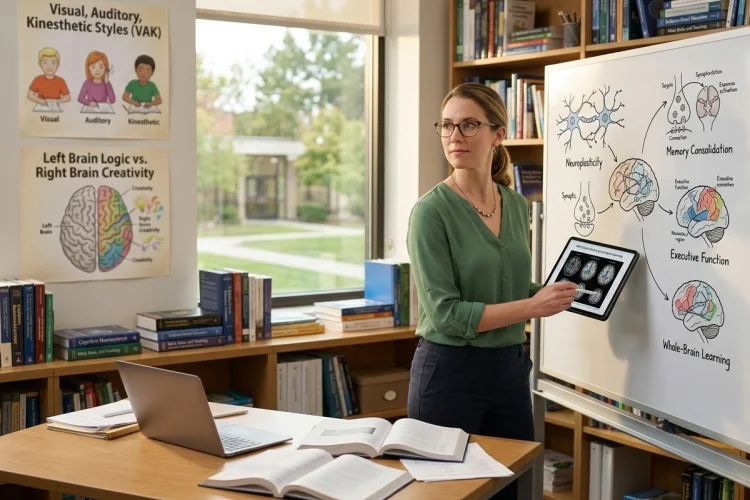
“Brain-friendly learning” sounds impressive, but the phrase can quickly lead teachers into questionable territory. Educational programs may promise to activate both sides of the brain, match lessons to a learner’s “brain type,” or unlock hidden mental potential. These ideas sound scientific, yet many belong to a collection of misconceptions known as neuromyths. Research with educators … Read more

Common Brain-Based Learning Myths Teachers Should Avoid

Common Brain-Based Learning Myths Teachers Should Avoid

Neuroscience can give teachers fascinating insights into attention, memory, development, and learning. The problem is that real scientific findings do not always reach classrooms in their original form. Somewhere between a research paper, a workshop, a social media post, and a teaching resource, a complicated idea can become a catchy but misleading claim. These misconceptions … Read more