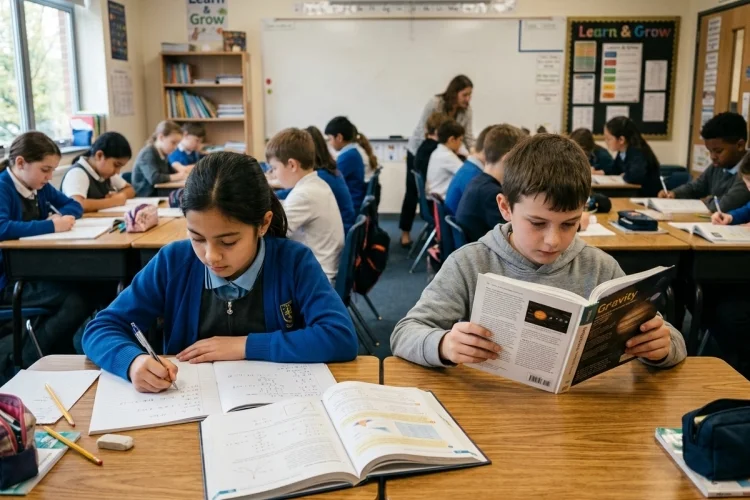
Imagine a student trying to solve a maths problem while remembering the teacher’s instructions, keeping several numbers in mind, and deciding which formula to use.
Another student is reading a paragraph while trying to connect the first sentence with information that appears several lines later. Both are relying heavily on working memory.
Working memory is the mental system that allows us to temporarily hold and use information while completing a task.
It supports activities such as reading, reasoning, problem-solving, following directions, and learning new material. Researchers often describe it as a limited-capacity system rather than an unlimited storage space.
Understanding how working memory supports learning in the classroom can help teachers design lessons that are easier to follow without making them less challenging.
When classroom demands exceed a learner’s working-memory capacity, important information may simply disappear before it can be understood or connected with existing knowledge.
Fortunately, small changes in instruction can make a big difference.
1. What Is Working Memory?
Working memory can be thought of as the brain’s temporary mental workspace.
It allows students to keep a small amount of information available while doing something with it. For example, when calculating 27 + 18 mentally, a learner may need to remember intermediate numbers while completing the calculation.
Alan Baddeley’s influential model describes working memory as containing several interacting components, including systems for verbal information, visual-spatial information, and attentional control.
This makes working memory different from long-term memory.
Long-term memory can store knowledge for extended periods. Working memory, meanwhile, keeps information temporarily active while the learner uses it.
A student may already know multiplication tables in long-term memory but still need working memory to keep track of the steps in a multi-stage maths problem.
2. Working Memory Has Limited Capacity
One of the most important facts for teachers is that working memory is limited.
Students cannot consciously hold and manipulate unlimited amounts of unfamiliar information at the same time.
Cowan describes working memory as retaining a small amount of information in a highly accessible form for processes such as comprehension, planning, and reasoning.
This becomes especially important when material is new.
Imagine telling students:
“Open page 84, read paragraphs two through four, underline three causes of the event, compare them with yesterday’s notes, and then write a two-sentence explanation.”
An experienced student may manage the sequence. Another may remember only “open page 84.”
The problem is not necessarily poor motivation or lack of attention. The instructions themselves may have placed too many unfamiliar pieces of information into working memory at once.
Cognitive Load Matters
The amount of mental processing demanded by a task is often discussed in terms of cognitive load.
When too much information competes for limited working-memory resources, learning becomes harder.
Research on cognitive load emphasizes that unnecessary complexity in explanations or instructional materials can consume resources that could otherwise be used for understanding.
Good teaching therefore does not remove all challenge. It removes unnecessary mental clutter.
3. Working Memory Helps Students Follow Instructions
Classroom instructions are one of the clearest examples of working memory in everyday education.
Students must hear or read the instruction, keep it active, understand what each step means, and carry out the steps in the correct order.
Consider a science teacher saying:
“Pour the water into the measuring cylinder, record the volume, add the object, and calculate the difference.”
Students must temporarily retain several actions while also handling equipment.
Long verbal directions can therefore become difficult even when each individual step is simple.
Teachers can reduce this pressure by breaking instructions into shorter stages, writing important steps on the board, demonstrating procedures, or allowing students to check instructions while working.
The goal is not to make students dependent on reminders. It is to prevent memory demands from hiding whether they actually understand the subject.
4. Working Memory Plays a Major Role in Reading
Reading looks automatic to experienced readers, but it places several demands on working memory.
A student must recognize words, understand their meanings, remember earlier information, and connect ideas across sentences.
Consider this example:
“Maria left her umbrella at home. When she arrived at school, her clothes were wet.”
To understand why Maria was wet, the reader must retain information from the first sentence while processing the second.
The demands increase dramatically with longer and more complicated texts.
Working memory is strongly connected with language comprehension and learning, and differences in working-memory ability can influence how easily students process complex verbal material.
Teachers can help by introducing important vocabulary before difficult reading, dividing long passages into meaningful sections, and pausing to summarize key ideas.
5. Maths Places Heavy Demands on Working Memory
Mathematics is another subject where limited working memory becomes easy to see.
Students frequently need to remember numbers, rules, symbols, and intermediate answers while completing calculations.
Take a problem such as:
48 × 17
A student solving it mentally must keep several pieces of numerical information active while performing multiple operations.
Research has found strong relationships between working memory and academic skills, including mathematics and reading.
A meta-analysis involving children with learning difficulties found working-memory weaknesses across groups experiencing reading and mathematics difficulties.
This does not mean working memory alone determines mathematical ability.
Previous knowledge matters enormously. When basic facts become well learned and easily retrieved from long-term memory, they consume less working-memory capacity.
A student who instantly knows that 7 × 8 = 56 has more mental resources available for solving a complicated problem than someone who must calculate that fact from scratch.
6. Prior Knowledge Frees Up Working Memory
One of the most useful classroom insights is that knowledge reduces cognitive effort.
Beginners often struggle because almost everything in a task is unfamiliar.
Imagine an experienced chess player and a complete beginner looking at the same board. The experienced player can recognize meaningful patterns, while the beginner may see many separate pieces.
Something similar happens in school subjects.
A student who already understands fractions can treat concepts such as numerator and denominator as familiar units. A beginner must consciously think about what each term means while also trying to solve the problem.
As information becomes organized in long-term memory, students can retrieve larger meaningful patterns instead of processing every detail separately.
This is why background knowledge, vocabulary instruction, practice, and review are so important.
Learning new material becomes easier when students already have a strong foundation to connect it to.
7. Working-Memory Differences Affect Classroom Performance
Not every student has exactly the same working-memory capacity.
Research involving school-age children has found meaningful individual differences in working memory and links between those differences and academic achievement.
A learner with lower working-memory capacity may appear forgetful during complicated tasks.
They might begin an assignment correctly but forget the next step, lose track while copying information, or struggle when instructions contain several stages.
Teachers can sometimes mistake these behaviors for carelessness.
Instead of assuming that a child “was not listening,” it can be useful to ask whether the task placed excessive demands on temporary memory.
Providing written instructions, checklists, worked examples, or smaller task stages can allow the student to focus on learning rather than constantly trying to remember what comes next.
8. Reducing Cognitive Overload Without Lowering Expectations
Supporting working memory does not mean making lessons easy.
The goal is to ensure that the difficulty comes from the concept being learned, not from unnecessary presentation problems.
For example, imagine a slide containing a complicated diagram, several paragraphs of text, animations, and a teacher explaining different information simultaneously.
Even if every element is educational, students may struggle to decide where to focus.
A cleaner explanation may work better.
Teachers can introduce one idea at a time, highlight essential information, provide worked examples before independent problems, and remove decorative material that does not help understanding.
Complex tasks can then gradually become more independent as students develop knowledge and confidence.
This approach respects working-memory limits while still encouraging challenging thinking.
9. Can Working Memory Simply Be Trained?
Commercial working-memory training programs sometimes promise large improvements in intelligence or academic achievement.
The evidence is more complicated.
Training can improve performance on working-memory tasks, particularly tasks similar to those being practiced. However, evidence for broad improvements in school achievement is much less consistent.
One study examining academic outcomes noted that improvements on working-memory tasks do not necessarily transfer strongly to reading or mathematics performance.
This suggests that teachers should be cautious about treating memory-training games as shortcuts to academic success.
A more practical strategy is to improve instruction itself.
Build subject knowledge, teach useful strategies, reduce unnecessary cognitive load, provide enough practice, and help students organize increasingly complex information.
10. Simple Ways Teachers Can Support Working Memory
Classroom support does not require special technology.
Start by keeping instructions clear and manageable. If a task has several stages, make those stages visible instead of expecting students to remember everything after hearing it once.
Connect new material with prior knowledge before adding complexity. Review important vocabulary and concepts so students do not need to process every element as completely new.
Worked examples can also help. Showing students how a problem is solved reduces unnecessary mental searching during the earliest stages of learning.
Finally, encourage students to use external memory supports.
Notes, diagrams, checklists, timelines, formula sheets, and graphic organizers are not forms of cheating when used appropriately. They reduce the burden on temporary memory so learners can focus on reasoning and understanding.
Understanding how working memory supports learning in the classroom helps explain why students sometimes struggle even when they are motivated and capable.
Working memory allows learners to temporarily hold and manipulate information while reading, solving problems, following instructions, and connecting new ideas with existing knowledge.
But its capacity is limited.
When lessons require students to process too many unfamiliar elements simultaneously, cognitive overload can interfere with understanding.
Teachers can respond by breaking complex tasks into manageable stages, making instructions visible, building prior knowledge, using clear examples, and reducing unnecessary distractions.
The next time students lose track during a lesson, look beyond whether they were simply paying attention. Consider what their working memory was being asked to handle-and whether the lesson can make that mental workload more manageable.