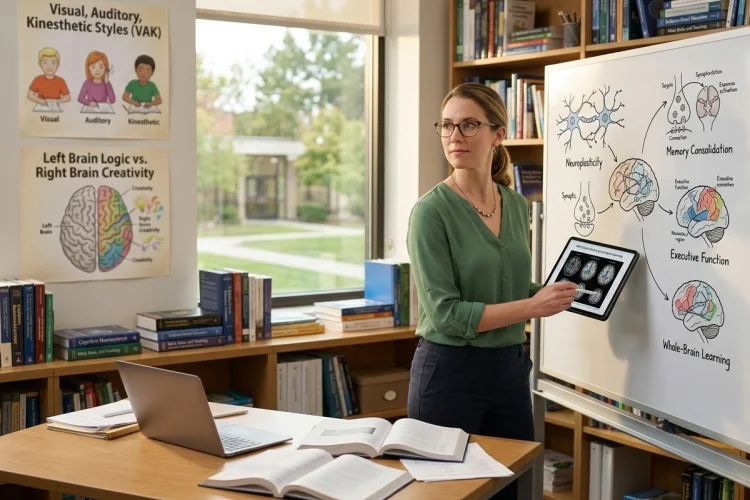
Neuroscience can give teachers fascinating insights into attention, memory, development, and learning. The problem is that real scientific findings do not always reach classrooms in their original form.
Somewhere between a research paper, a workshop, a social media post, and a teaching resource, a complicated idea can become a catchy but misleading claim.
These misconceptions are often called neuromyths.
Some brain-based learning myths sound scientific enough to be convincing. You may have heard that students should be taught according to whether they are visual, auditory, or kinesthetic learners.
Other popular claims suggest that creative students are “right-brained,” people use only 10% of their brains, or special exercises can activate unused brain areas.
Research shows that several of these beliefs remain surprisingly common among educators.
Understanding common brain-based learning myths teachers should avoid matters because inaccurate ideas can influence lesson planning, expectations, and how students see their own abilities. Here are some of the biggest myths and what teachers can do instead.
1. Myth: Every Student Has One Learning Style
Perhaps the most famous educational neuromyth is the idea that students can be classified as visual, auditory, or kinesthetic learners and will learn more effectively when teaching matches their preferred style.
Students certainly have preferences. One learner may enjoy diagrams while another prefers listening to explanations. The problem comes when preference is treated as a biological learning category.
A major review by Pashler and colleagues found insufficient evidence for the so-called meshing hypothesis-the idea that matching teaching methods to an individual’s learning style improves learning.
More recent research continues to challenge using learning-style categories as a basis for instructional decisions.
What Teachers Can Do Instead
Choose the format that best fits what is being taught, rather than labeling the learner.
Maps are naturally useful for geography. Pronunciation requires listening. Physical techniques often need demonstrations and practice. A science process may be clearer when students combine written explanations, diagrams, demonstrations, and discussion.
Multimodal teaching can be valuable without assuming that every child belongs to one fixed sensory category.
2. Myth: Students Are Either Left-Brained or Right-Brained
Another popular idea divides people into two groups: logical, analytical “left-brained” learners and imaginative, artistic “right-brained” learners.
There is a small piece of real neuroscience behind the myth. Some functions do show hemispheric lateralization.
Language processing, for example, is more strongly lateralized to the left hemisphere in many people, while some visuospatial processes show stronger right-hemisphere involvement.
But that does not mean people generally think or learn using only one dominant side.
A large neuroimaging analysis found no evidence supporting the popular idea that individuals have globally stronger left- or right-brain networks corresponding to personality types.
Real learning normally requires networks distributed across both hemispheres.
A student writing a creative story is not simply “using the right brain.” They may be retrieving vocabulary, organizing sentences, imagining scenes, remembering experiences, controlling hand movements, and evaluating ideas-all requiring coordinated neural systems.
3. Myth: We Only Use 10% of Our Brains
The claim that humans use only 10% of their brains has survived for generations.
It sounds exciting because it implies that unlocking the remaining 90% might provide extraordinary intelligence. Unfortunately, that is not how the brain works.
Research on neuromyths consistently identifies the 10% claim as a widespread misconception.
Different brain regions contribute to different functions, and activity changes depending on whether someone is reading, moving, sleeping, remembering, speaking, or performing another task.
That does not mean every neuron fires at maximum intensity simultaneously. In fact, having every neuron intensely active at once would not represent better thinking.
Why This Matters in the Classroom
Teachers do not need special tricks designed to “activate unused brain areas.”
Effective instruction should instead help students build knowledge, retrieve information, solve problems, receive feedback, and practice useful skills.
The goal is not to activate more brain. It is to support better learning.
4. Myth: Neuroplasticity Means Anyone Can Learn Anything Easily
Neuroplasticity is real. The nervous system can change structurally and functionally in response to experience, learning, injury, and other influences.
However, popular discussions sometimes turn this fascinating ability into another myth:
“Because the brain is plastic, anyone can completely rewire their brain to achieve anything.”
That goes too far.
Plasticity is influenced by development, previous experience, genetics, health, environment, the type of skill being practiced, attention, motivation, and many other variables.
Brain changes can also be neutral or even maladaptive rather than automatically beneficial.
For teachers, neuroplasticity should provide a reason to value practice and improvement-not a reason to promise unlimited outcomes.
A struggling student can often improve considerably with appropriate instruction and practice, but students will not necessarily progress at identical speeds or reach identical outcomes.
5. Myth: More Brain Stimulation Always Means Better Learning
Educational products sometimes promise to “activate the brain,” “boost neural activity,” or stimulate multiple brain regions as though more activation automatically produces more learning.
Neuroscience does not work that way.
The brain needs coordinated patterns of activity appropriate to a task. Effective learning is about how neural systems process and organize information, not simply how many areas are active.
This is similar to an orchestra. A great performance does not happen because every musician plays as loudly as possible. It happens because the right musicians perform the right parts at the right time.
Teachers should therefore be cautious when educational programs use impressive neuroscience vocabulary without demonstrating improved learning outcomes.
Terms such as dopamine, brain activation, neural pathways, neuroplasticity, or hemisphere integration do not automatically make a teaching method scientifically validated.
Ask a simpler question: Is there good evidence that students actually learn better?
6. Myth: Multitasking Trains Students to Learn More Efficiently
Students may believe they can listen to a lesson, answer messages, watch short videos, and work on an assignment simultaneously without any cost.
Human attention is more limited than that.
People can sometimes perform simple or highly practiced activities together. But when two demanding tasks require attention, what feels like multitasking often involves repeatedly shifting between tasks.
Research on media multitasking has associated multitasking during learning with poorer academic outcomes and difficulties involving attention and memory.
Imagine a student reading a complicated history paragraph while responding to messages every minute. Each interruption requires attention to move away from the text and later return.
Even when the interruption lasts only a short time, the student must repeatedly reconstruct what they were thinking about.
A Better Classroom Approach
For tasks requiring deep thinking, encourage periods of focused attention.
This does not require banning technology from every lesson. Devices can be excellent learning tools when they serve a clear instructional purpose.
The key difference is between using technology for the task and allowing unrelated information to compete continuously for attention.
7. Myth: Childhood Is the Only Time the Brain Can Really Learn
Childhood contains important periods of rapid brain development, and certain abilities have sensitive developmental windows.
That scientific fact can become exaggerated into the belief that once childhood ends, major learning becomes impossible.
It does not.
Brain plasticity continues beyond childhood. Adolescents and adults remain capable of developing knowledge, modifying neural networks, learning languages, improving professional skills, and practicing complex physical abilities.
Research on neural plasticity demonstrates that learning-related changes continue beyond early development.
Age can certainly influence learning. For example, acquiring some aspects of a second language may differ when learning begins early versus later.
But “different” does not mean “impossible.”
This distinction is particularly important because telling students that their brains have missed a developmental window can create unnecessarily limiting expectations.
8. Myth: Brain-Based Labels Help Students Understand Their Strengths
Labels can feel helpful because they simplify complexity.
A teacher might say that one student is a “visual learner,” another has a “logical left brain,” and another is naturally a “creative right-brain thinker.” Unfortunately, students can begin treating these descriptions as permanent limits.
A child who believes, “I am a visual learner, so I cannot learn by listening,” may avoid practicing useful listening strategies. A student labeled “creative rather than mathematical” may start believing mathematics simply is not for them.
Teachers can acknowledge genuine differences without turning students into fixed neurological categories.
Instead of saying, “You are a visual learner,” try thinking about the specific strategy that works:
“You understood this diagram well. Let’s connect it to the written explanation.”
That language focuses on strategies and evidence, not supposedly fixed brain types.
9. How Teachers Can Spot a Neuromyth
Teachers do not need to become neuroscientists to evaluate every educational claim.
A little healthy skepticism goes a long way.
Be cautious when a teaching product promises dramatic improvement by “activating” a particular brain region, balancing hemispheres, matching a neurological learning type, or unlocking unused brain capacity.
Also look beyond testimonials.
A classroom strategy may be enjoyable and still lack evidence that it improves learning. Conversely, a method does not need sophisticated neuroscience terminology to be effective.
Research on neuromyth interventions suggests that explicitly explaining and correcting misconceptions can reduce belief in them, although false ideas can be surprisingly persistent.
The best question is often not, “Does this sound brain-based?”
It is: “What does reliable evidence say about whether students learn from it?”
Common brain-based learning myths teachers should avoid often begin with a small piece of genuine science before becoming oversimplified. Learning styles turn sensory preferences into fixed categories.
Brain lateralization becomes “left-brained versus right-brained” personalities. Neuroplasticity becomes unlimited rewiring, while ordinary attention is sometimes treated as effortless multitasking.
Real neuroscience is more interesting-and more complicated.
The brain learns through interconnected systems that change with experience, attention, practice, development, and many other influences. Teachers do not need neuroscience gimmicks to support those processes.
Instead, focus on clear explanations, meaningful practice, retrieval, useful feedback, appropriate challenge, and focused attention. When you encounter the next impressive “brain-based” teaching claim, investigate the evidence before bringing it into the classroom.